Tiny house living has exploded in popularity, and for good reason. But here’s what most people don’t realize: you don’t have to sacrifice outdoor recreation just because your footprint is small. Adding a pool to a tiny house sounds counterintuitive until you see it done right. In 2026, smart homeowners are discovering that a well-designed pool can actually enhance a compact property by creating a functional outdoor retreat without eating up the entire yard. Whether you’re thinking about downsizing or maximizing an existing small property, understanding how to fit a pool into a tiny house layout is the key to making the most of your outdoor space.
Table of Contents
ToggleKey Takeaways
- A tiny house with pool enhances outdoor living and property value when sized appropriately to the lot, creating a functional retreat without dominating the yard.
- Above-ground and plunge pools are the most practical options for compact properties, costing $2,000–$5,000 installed and avoiding expensive excavation permits.
- Saltwater systems and proper pump sizing ($800–$2,000) are essential for small pools, preventing algae blooms and reducing long-term chemical costs.
- Weekly maintenance on small pools takes just 15–20 minutes, making upkeep faster and chemical imbalances develop slower than traditional large pools.
- Local permits, 4-sided fencing, GFCI electrical installation, and proper drainage are non-negotiable legal requirements that prevent fines exceeding $10,000 and insurance claim denials.
- Composite or stamped concrete decking ($2,000–$5,000) adds durability and low-maintenance appeal, ensuring your tiny house pool stays accessible and beautiful year-round.
Why Homeowners Are Adding Pools to Tiny Homes
The shift toward tiny house living doesn’t mean giving up the things you love, it means being intentional about them. Pools aren’t just for sprawling estates anymore. Homeowners with compact properties are realizing that a small, well-placed pool adds genuine value to daily life: cooling off on hot days, entertaining guests in an intimate setting, and creating a focal point for an otherwise modest outdoor area.
Beyond lifestyle appeal, a thoughtfully integrated pool can actually increase property value. Unlike a oversized pool on a small lot (which can look awkward and limit usable space), a proportional pool becomes part of the home’s identity. Modern tiny house buyers increasingly expect amenities that deliver quality-of-life benefits in limited square footage. A small saltwater or fibreglass pool, the right size and placement, signals that the property has been designed with care, not just downsized.
There’s also the practical angle: many tiny house dwellers are younger professionals or retirees who value experience over possession. A pool in your backyard means no membership fees, no commute to a community center, and complete control over when and how you use it. For remote workers or those with flexible schedules, that convenience is worth the planning effort upfront.
Smart Pool Designs for Tiny House Spaces
Not all pools are created equal, and size matters far more in tight spaces. The key is choosing a pool type and configuration that fits your lot, lifestyle, and budget without dominating the yard.
Above-Ground and Compact Options
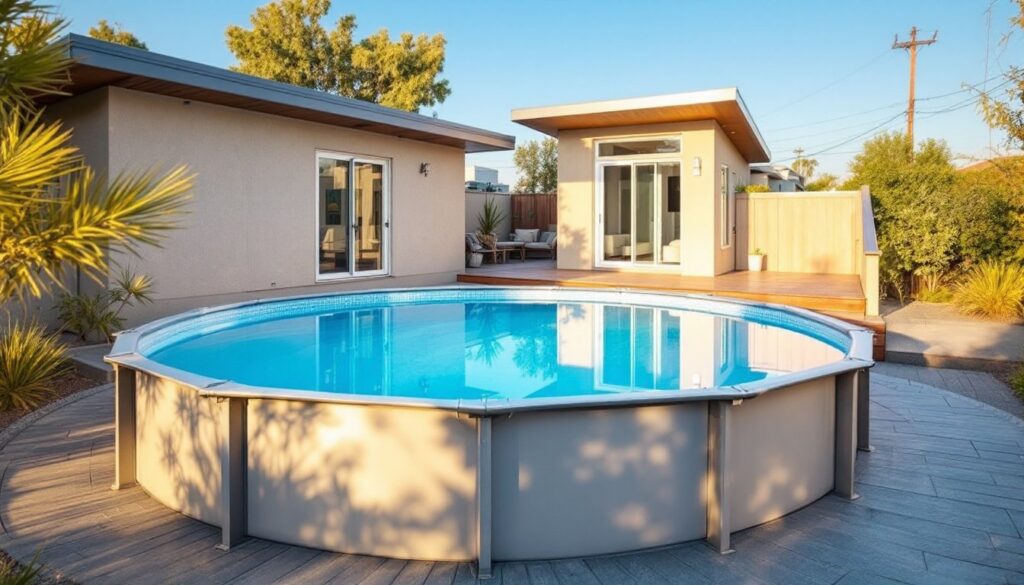
Above-ground pools are the obvious starting point for tiny houses. A standard 18-foot round pool takes up roughly 250 square feet and sits 48–52 inches above ground, manageable for most residential lots. Unlike in-ground pools, above-ground models don’t require excavation, which saves thousands in labor and avoids the need for permits in many jurisdictions (though local codes vary, so check yours).
Saltwater systems have become popular for small pools because they use chlorine generators instead of manual dosing, require less frequent water changes, and are gentler on skin and equipment. For a tiny house pool, a saltwater system actually makes sense: the smaller water volume means lower chemical costs overall.
For ultra-compact properties, plunge pools, typically 6 feet wide by 12–15 feet long and 3–4 feet deep, are a legitimate option. They’re too small for lap swimming but perfect for cooling off, wading, or creating a visual and recreational anchor in a small yard. Built-in plunge pools (custom or prefab fiberglass) run $4,000–$12,000 depending on finishes and site conditions. Above-ground alternatives cost $2,000–$5,000 installed.
Container pools (made from shipping containers or stock tanks) are trending in the tiny house community. A converted 40-foot container yields about 320 gallons: a stock tank offers 1,000–2,500 gallons depending on diameter. These are cheaper than traditional pools, $1,500–$4,000, and fit the DIY ethos. Just ensure proper drainage, electrical safety, and local code compliance before you immerse.
Placement is everything. Position your pool where it drains naturally away from the foundation, gets 6–8 hours of sun (or shade, if you prefer), and doesn’t block sight lines from living spaces. In tiny house design, visual flow matters, a pool you can see from your kitchen window becomes part of the home’s character.
Materials and Budget Considerations
Budget constraints often drive tiny house decisions, and pools are no exception. Understanding material costs upfront prevents sticker shock and helps you prioritize.
Vinyl-lined pools (above-ground or shallow in-ground) are the most affordable for DIY-friendly setups. A vinyl liner lasts 7–10 years and costs $1,000–$3,000 to replace, expensive but spreads across years. Fibreglass pools are pricier upfront ($6,000–$15,000 for a small size) but last 25+ years with minimal maintenance, making them cost-effective long-term.
Concrete (gunite) pools offer durability and design flexibility but require professional installation and are overkill for most tiny properties. Skip it unless you’re building a custom home and have the budget.
Decking matters too. Composite decking ($15–$25 per square foot installed) avoids rot and needs less maintenance than wood, valuable when space is tight and upkeep time is precious. Pavers or stamped concrete ($10–$18 per square foot) also work and integrate well with modern tiny house aesthetics. Budget $2,000–$5,000 for decking around a small pool, depending on materials and area size.
Don’t cheap out on the pump and filter system. An undersized pump means poor water circulation and algae bloom. For a pool under 400 gallons, a 0.75–1.5 horsepower pump suffices: above that, 2–3 horsepower is standard. A quality system runs $800–$2,000 and last 10–15 years if maintained. As one source notes, tiny homes in Hawaii demonstrate that smart spatial planning applies to outdoor living too, prioritizing durability and low-maintenance materials saves money over time.
Essential Maintenance Tips for Small-Space Pools
A tiny pool isn’t necessarily easier to maintain, it’s just more forgiving and faster to manage. The smaller volume is actually an advantage: chemical imbalances develop slower, and repairs affect less water.
Weekly tasks include testing chlorine (0.5–1.5 ppm for saltwater, 1–3 ppm for traditional chlorine), pH (7.2–7.8), and alkalinity (80–120 ppm). Skim debris daily if your pool is under trees, leaves break down quickly in small volumes. Brush walls and floor twice weekly to prevent algae film. These chores take 15–20 minutes on a small pool versus hours on larger ones.
Monthly tasks involve cleaning the filter and checking the pump strainer basket. A clogged filter reduces flow, stressing the pump and shortening its life. For saltwater systems, inspect the salt cell monthly and clean if calcium buildup appears.
Winterization (if you live in cold climates) requires draining or closing the system. For above-ground pools, you can partially drain and cover. In-ground pools need a professional winterization service ($300–$500) to protect plumbing and equipment. Always shut down the pump and filter in freezing weather, running it risks burst pipes.
Algae prevention is easier in small pools: keep chlorine levels consistent, maintain circulation, and avoid overheating (water above 85°F accelerates algae growth). If green water appears, test first, it’s usually a chlorine deficiency, not a catastrophe. For ongoing guidance, design sites like Apartment Therapy occasionally feature small-space pool layouts that prioritize low-maintenance designs.
Legal and Safety Requirements to Know
Pools trigger building codes and liability concerns that vary wildly by location. Ignoring them can mean fines, denied insurance claims, or worse.
Permits: Check your local jurisdiction before breaking ground. Above-ground pools under a certain size (often 18 feet or less, 2 feet deep) may be exempt from permits in some areas. In-ground or saltwater pools almost always require one. A permit costs $50–$300 but ensures your pool meets electrical, drainage, and structural codes.
Fencing and gates: Most jurisdictions require a 4-sided fence (minimum 4 feet high) with a self-closing, self-latching gate around any pool deeper than 24 inches. This applies to both above-ground and in-ground pools. Penalties for non-compliance can exceed $10,000 and affect your homeowner’s insurance. Check the IRC (International Residential Code) for your region’s specific requirements.
Electrical safety: Install a GFCI (ground fault circuit interrupter) outlet for all pool equipment, pump, heater, lights, within 6 feet of the water. A GFCI detects current leaks and shuts off in milliseconds, preventing electrocution. This is non-negotiable and required by the NEC (National Electrical Code). If you’re unfamiliar with electrical work, hire a licensed electrician ($300–$800 for GFCI installation and inspection).
Drainage: Ensure the pool area drains away from the foundation and any neighbor’s property. Poor drainage causes erosion, foundation problems, and disputes. Grade the surrounding area slightly away from structures and install a sump pump if the lot is naturally wet. Professional drainage assessment costs $200–$500 but prevents expensive fixes later.
Insurance: Notify your homeowner’s insurance about the pool. Most policies require it and may adjust your premium. Liability coverage jumps to $500,000–$1,000,000 for pools in most policies, necessary given drowning and injury risks. Skipping this creates a gap you’ll regret in an accident. Advanced construction guidance on safety standards is available through Fine Homebuilding, which regularly covers pool-related building science.
Conclusion
Adding a pool to a tiny house works when you plan for scale, choose materials wisely, and respect local codes. Above-ground or plunge pools, paired with low-maintenance systems and proper drainage, create a genuine retreat without consuming your property. Start small, invest in a reliable pump and filter, secure permits early, and commit to seasonal upkeep. Your compact oasis isn’t just a feature, it’s proof that thoughtful design beats square footage.