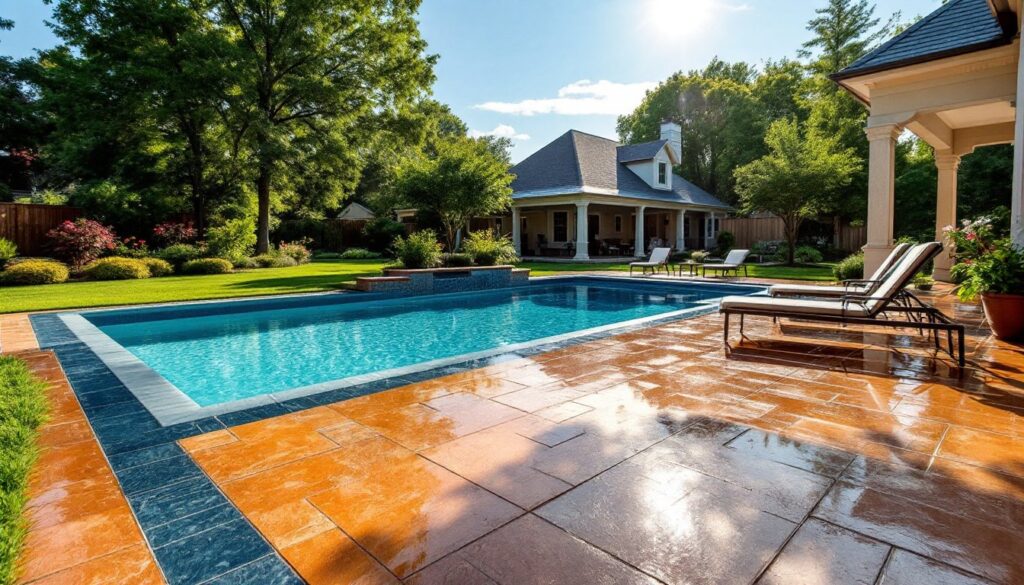
Your inground pool is a major investment, but what surrounds it matters just as much. A well-designed concrete pool deck doesn’t just look great, it provides safe, non-slip footing, frames the pool beautifully, and can dramatically increase your backyard’s functionality. Whether you’re building a new pool or refreshing an existing deck, concrete offers versatility, durability, and design options that fit nearly every aesthetic and budget. From stamped patterns to stained finishes, today’s concrete pool deck ideas go far beyond plain gray slabs, letting homeowners create stunning outdoor spaces that last for decades with minimal fuss.
Table of Contents
ToggleKey Takeaways
- Stamped concrete pool deck ideas provide upscale visual impact at 30–50% less cost than authentic pavers, with patterns mimicking slate, stone, or wood grain for any aesthetic.
- Stained concrete offers rich color options through acid-based or water-based stains, and combining them with epoxy topcoats enhances durability and slip resistance for pool environments.
- Textured finishes like salt-finish and exposed aggregate concrete improve safety by reducing slip hazards when wet, making them essential for families with children or elderly relatives.
- Permeable concrete drains water through the deck surface, eliminating standing water, reducing chlorine runoff, and improving safety in wet climates—costing only 10–20% more than standard concrete.
- Consistent maintenance including weekly sweeping, annual sealing reapplication every 1–2 years, and managing chlorine exposure keeps your concrete pool deck looking fresh for decades.
- Plan decorative borders and accent patterns carefully with your contractor to balance visual appeal with proper drainage slope (1/8 inch per foot) and avoid safety hazards.
Stamped Concrete Designs for Visual Impact
Stamped concrete is the go-to choice when homeowners want dramatic visual impact without the cost of natural stone or pavers. During installation, contractors press molds into the freshly poured concrete to create patterns that mimic slate, ashlar (rectangular blocks), cobblestone, or wood grain. The result looks upscale but costs significantly less than the real materials, typically 30–50% less than authentic pavers.
Common stamp patterns for pool decks include ashlar slate, which creates a clean geometric look, and random stone, which mimics natural layering for a more organic feel. Wood grain patterns work well for a warmer aesthetic, while geometric designs suit modern homes. The key to successful stamped concrete is proper timing: contractors must release the stamps at precisely the right moment when the concrete has set enough to hold impressions but remains pliable enough not to crack.
One critical note: stamped concrete requires a release agent (a powder or liquid) applied before stamping to prevent the molds from sticking. This also colors the surface slightly, adding depth to the pattern. After stamping and curing, a quality sealer should be applied to protect against UV fading, chlorine damage, and water absorption. Without sealing, stamped decks can lose their vibrant appearance within 2–3 years in harsh pool environments.
Stained Concrete Options for Color and Character
Stains offer another route to personalize concrete without the texture of stamping. There are two main types: acid-based stains and water-based stains.
Acid stains create rich, variegated colors by chemically reacting with the lime in concrete, producing earth tones like terracotta, amber, sage green, and slate blue. These stains are semi-transparent, so they enhance the concrete’s natural variation rather than painting over it. The process is irreversible, which means you’re committed to the color, that’s why test samples are essential.
Water-based stains are newer, more environmentally friendly, and come in a wider color palette, including brighter hues and pastels. They sit on the surface rather than reacting chemically, so they’re slightly less durable than acid stains but more forgiving if you want to change colors later.
For pool decks, stains are often combined with epoxy topcoats for added durability and slip resistance. The epoxy seals the stain and provides a protective barrier against chlorine, UV rays, and foot traffic. A professional application typically costs $3–$8 per square foot, depending on whether you’re staining a new pour or existing concrete. If staining existing concrete, surface prep is non-negotiable, grease, algae, and efflorescence (white mineral deposits) must be removed, or the stain won’t adhere evenly. Many homeowners pair stained finishes with deck paint techniques to create custom borders and accents.
Textured Finishes for Safety and Aesthetics
Textured concrete surfaces serve a dual purpose: they’re safer underfoot when wet and add visual depth to an otherwise flat slab. Unlike smooth broom-finish concrete (the standard grey stuff), textured options grip moisture and reduce slip risk, a major safety consideration around water.
Broom finish, achieved by dragging a broom across wet concrete, creates fine parallel lines and costs almost nothing extra. It’s adequate but fairly basic. For better traction and appearance, consider a salt-finish (or salt-float finish), where rock salt is embedded into the surface while concrete is still plastic, then washed away to leave dimpled pits. This creates excellent grip and a subtle aggregate appearance without the cost of stamping.
Another option is exposed aggregate, where the top layer of concrete is chemically dissolved or lightly ground to reveal the colorful gravel beneath. Granite chips, river rock, or recycled glass can be mixed into the concrete before pouring for custom colors, whites, blues, blacks, or earth tones. Exposed aggregate is slip-resistant, durable, and striking, though slightly more expensive than plain concrete ($2–$4 per square foot more for material and labor).
For families with small children or elderly relatives, slip resistance is non-negotiable. Textured finishes provide that safety margin without requiring slippery sealers or coatings. If you choose a glossy sealer (like epoxy), apply a non-skid additive to maintain traction.
Decorative Borders and Accent Patterns
Borders frame a pool deck visually and can define different zones (lounging area, shallow end, entry point). Concrete borders are created in several ways: stamping different patterns in the perimeter, staining a contrasting band around the edge, or pouring a separate concrete ribbon with a different finish.
One popular approach combines a central area of one finish with a 2–3 foot border in a contrasting pattern. For example, a salt-finish main deck with a stamped ashlar border creates visual interest without overwhelming the space. Another idea is to use contrasting stain colors, a warm terracotta center with a slate-blue border, for instance.
Built-in concrete benches or seat walls can also be formed during the initial pour and stained or sealed differently from the main deck. These provide functional seating and add architectural character.
When planning decorative elements, remember that pool decks need sufficient slope for drainage, typically 1/8 inch per foot away from the pool. Complex patterns can disrupt water flow, so discuss drainage logistics with your contractor during the design phase. Improper slope leads to standing water, mold, and safety hazards. Work with a professional to balance aesthetics with function: remodeling decks and patios requires careful planning to achieve both.
Permeable Concrete for Drainage Solutions
Permeable (or porous) concrete is a game-changer for pool decks in wet climates or areas with standing water problems. Instead of pooling water on the surface, permeable concrete allows rainfall to drain through it into a gravel base or French drain beneath, reducing splash zones and improving safety.
Permeable concrete uses larger aggregate and no fine sand, creating voids throughout the material. Water passes through these voids rather than running off the surface. Structurally, it’s slightly weaker than standard concrete, so it’s better suited for decking (light foot traffic) than for areas supporting vehicles or heavy equipment. Load-bearing capacity is generally adequate for residential pool decks, but always consult local building codes, some jurisdictions have specific requirements for permeable surfaces.
The environmental benefits are significant: reduced runoff means less chlorine and other pool chemicals entering local waterways. Installation costs roughly 10–20% more than standard concrete because of the specialized mix design and subgrade preparation. But, in areas with heavy rainfall or poor drainage, the long-term payoff is worth it, no more algae on standing water, fewer slip hazards, and better water management.
Maintenance is straightforward: sweep or vacuum periodically to prevent sediment from clogging the pores. Power-washing is possible but should be done gently to avoid forcing debris too deep into the material. Homeowners planning backyard decks and patios in water-prone zones should seriously evaluate permeable options with their contractor.
Maintenance Tips to Keep Your Deck Looking Fresh
A concrete pool deck’s longevity depends on consistent care. Here’s what to do:
Regular Cleaning: Sweep weekly to remove debris and algae growth. Use a soft-bristle brush and mild soap with water for light cleaning. Avoid steel brushes on sealed finishes, they scratch the sealer.
Seasonal Power-Washing: Once or twice a year (spring and fall), pressure-wash at 1,500 PSI or lower to remove algae, mineral deposits, and chlorine residue. Higher pressures can damage stamped patterns or expose concrete.
Sealer Application: Reapply sealer every 1–2 years, depending on traffic, sun exposure, and the sealer type. Acrylic sealers (cheapest) last 1 year. Polyurethane and epoxy sealers last 2–3 years. A quality sealer costs $50–$150 per 1,000 square feet and takes one weekend to apply.
Manage Chlorine Exposure: Pool chemistry affects concrete. Maintain proper chlorine levels (2–4 ppm) and alkalinity (80–120 ppm) to prevent etching. Drain splash-out water regularly, don’t let it pool on the deck.
Repair Cracks Early: Small cracks (hairline width) can be sealed with polyurethane caulk. Wider cracks may indicate settling or structural issues and should be inspected by a professional. Ignoring cracks allows water infiltration, which worsens damage in freeze-thaw climates.
Check Slope: Over time, concrete can settle unevenly, disrupting drainage. If water starts pooling where it didn’t before, your contractor may need to address settling or regrade the surface. Resources like ImproveNet and Houzz can help you find qualified contractors for repairs.
Conclusion
Concrete pool decks offer flexibility, durability, and style at a price point that rivals few other materials. Whether you choose stamped patterns, vibrant stains, textured finishes, or permeable surfaces, you’re investing in a deck that will serve your family safely and beautifully for years to come. Start by clarifying your priorities, aesthetics, safety, drainage, or a mix, then consult with an experienced contractor who understands pool deck specifics. With proper installation and maintenance, your concrete deck will remain a stunning centerpiece of your backyard oasis.